Choosing the right clinical waste partner is a compliance decision before it’s a commercial one. Under Australian regulations, your practice remains the waste generator and carries duty-of-care obligations even after the bin leaves your premises. If your provider isn’t properly licensed, the penalty can still land at your door. Whether you run a hospital, dental practice, GP clinic, vet surgery or aged care home, here are seven things to check before you sign with a certified medical waste provider.
1. Verify their state licence is current and matches your waste stream
Clinical waste in Australia is regulated state by state, and the licence rules differ more than most generators realise. In Queensland, providers must hold an Environmental Authority issued by the Department of Environment under the Environmental Protection Act. In Victoria, transporters and treatment facilities are licensed separately under EPA Victoria’s permissions framework. Ask for the licence number, the issuing authority, the expiry date and the specific waste codes covered. A genuinely licensed clinical waste provider in Australia will send this through within minutes.
If you operate across multiple states, confirm your provider holds the right authority in each one. A Queensland Environmental Authority does not extend to a Melbourne site, and assuming otherwise is one of the most common compliance gaps we see in new client audits.
2. Confirm they own (or have direct access to) a treatment facility
Some operators are middlemen who sub-contract collection or treatment. That isn’t automatically a red flag, but every additional handover lengthens your chain of custody and creates more points where documentation can break down. Providers who own and operate their own EPA-approved treatment facility give you a shorter, more transparent path from bin to disposal. Ace Waste, for example, operates high-temperature incinerators in Willawong (QLD) and Dandenong (VIC), so your waste is treated in-house at a licensed clinical waste disposal facility rather than relayed through third parties you’ve never vetted.
3. Ask which treatment method they use, and why
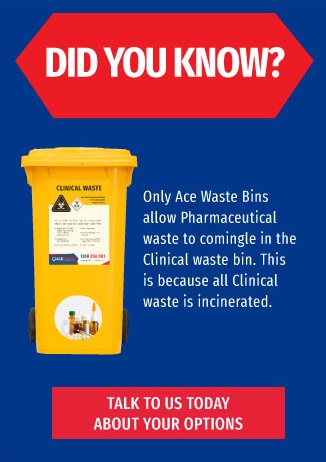
Not all treatment is equal, and the right method depends on the waste type. The two common approaches in Australia are autoclaving (steam sterilisation) and high-temperature incineration. Cytotoxic waste, anatomical waste and most pharmaceutical waste must legally be incinerated; autoclaving is suitable for many general clinical streams but not all. A capable provider will walk you through which method applies to which bin at your site, in plain language. If you generate cytotoxic or pharmaceutical waste in any volume, an incineration-capable provider isn’t optional.
4. Check the clinical waste bins meet Australian Standards
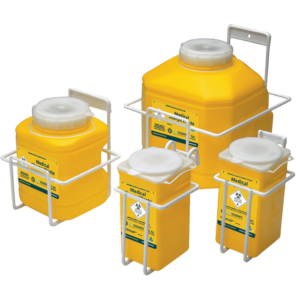
Your provider should supply colour-coded clinical waste bins that comply with AS 3816 for clinical and related waste, and AS 4031 for sharps. In practice, that means yellow bins clearly marked with the biohazard symbol, leak-proof construction, secure lids and a size mix matched to your generation rate. Most dental and GP practices run on 50-litre or 120-litre bins; busier day surgeries and hospitals usually need 240-litre, 660-litre or 1100-litre units. Ask to see the bin specifications in writing before signing. Vague answers about ‘compliant’ bins, with no standard cited, are a signal to keep looking.
5. Look for real-time tracking and waste documentation
Australian regulations require generators to keep records of waste type, volume, transporter and disposal point, and to produce them on request during an audit. Modern providers automate this through digital tracking systems. Ace Waste’s tracking platform, Ace Waste Live, captures collection and disposal data in real time so clients can pull reports without chasing paperwork. When evaluating a provider, ask whether they issue consignment notes for each pickup, monthly disposal certificates and audit-ready records covering at least the past 24 months. If you’re inspected, this documentation is what protects your practice.
6. Review their environmental and safety performance
A certified medical waste provider should be measurably better for the environment than landfill alternatives. Ask how much of the waste stream is diverted from landfill, what emissions controls are in place at their treatment facility, and whether they hold any third-party environmental certifications. High-temperature incineration, properly engineered with air pollution control, destroys pathogens completely and produces far fewer emissions than treat-and-landfill pathways. A provider that can speak to this in detail is one that takes both compliance and sustainability seriously.
7. Test their service flexibility and support
Compliance is non-negotiable, but day-to-day service still decides whether the relationship works. Check collection frequency options, the process for emergency or extra pickups, minimum contract terms, and whether the provider offers a waste audit to right-size your service. A good audit usually surfaces general waste being misclassified as clinical, which is the single biggest avoidable cost we see in healthcare practices. Also confirm that local support is genuinely local. A Brisbane or Melbourne practice shouldn’t have to escalate through an interstate call centre to get a missed bin sorted.
A quick checklist before you sign
Before committing to any clinical waste provider, ask for: a copy of their current state environmental licence; treatment facility location and approval details; bin specifications and Australian Standards compliance; a sample consignment note or tracking report; landfill diversion and emissions information; a pricing structure with no hidden minimum-tonnage clauses; and reference clients in your industry. If a provider hesitates on any of these, that’s your answer.
Ready to switch to a licensed, certified clinical waste partner?
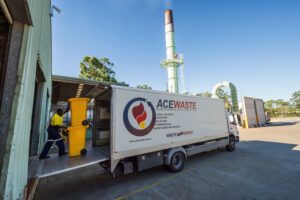
Ace Waste has been the trusted clinical waste partner for hospitals, GPs, dentists, vets and aged care providers across Brisbane and Melbourne since 1987. Fully licensed in QLD and VIC, with in-house EPA-approved incineration and real-time waste tracking, we make compliance straightforward. Get in touch with our team for a no-obligation quote and waste audit.
Frequently asked questions
How long do I need to keep clinical waste disposal records in Australia?
Most state regulators require generators to keep waste records for two to five years. Store consignment notes, monthly disposal certificates and a copy of your provider’s current licence.
What’s the penalty for using an unlicensed clinical waste provider?
You remain the waste generator under Australian law, so fines can land on your practice even when the fault sits with the contractor. Penalties range from thousands to tens of thousands per breach.
Can one clinical waste provider service both Queensland and Victoria?
Yes, but only if they hold the correct environmental authority in each state. QLD and VIC licences don’t cross-recognise, so ask for separate licence numbers for each site you operate.
What’s the difference between autoclaving and incineration for clinical waste?
Autoclaving uses high-pressure steam and suits general clinical streams like swabs and PPE. Incineration is legally required for cytotoxic, anatomical and most pharmaceutical waste.