If you run a medical practice, dental clinic, vet surgery, aged care home or any business that generates healthcare waste, getting your clinical waste bins right is not optional. In nearly four decades of collecting clinical waste from Australian healthcare facilities, the most common compliance issue we see is not malice or negligence. It is a quiet drift in segregation habits, where one busy shift puts a sharp in the wrong container or an anatomical item ends up in a standard yellow bag.
The good news is that Australia follows a clear national standard, AS/NZS 3816, that takes most of the guesswork out of segregation. This guide walks you through what clinical waste actually is, the colours used across every state and territory, and exactly what belongs in each bin.
What is clinical waste?
Clinical waste is any waste produced during medical, nursing, dental, veterinary, pharmaceutical or skin-penetration activities that has the potential to cause injury, infection or offence. That includes human tissue, blood-stained materials, laboratory cultures, used sharps and pharmaceutical products. It does not include items like hair, teeth or nails, or general office rubbish from a healthcare setting.
A useful test we share with new clients during waste audits is this: if the item has come into contact with blood, body fluids or infectious material, treat it as clinical. If you are unsure, segregate it as clinical rather than risk cross-contamination. Because clinical waste can carry pathogens, it must be packaged in compliant containers and treated by incineration or autoclaving rather than sent to landfill.
Clinical waste bin colours in Australia
Colour coding is the foundation of safe segregation. Here is what each colour means under Australian Standards.
Yellow bins (clinical and infectious waste)
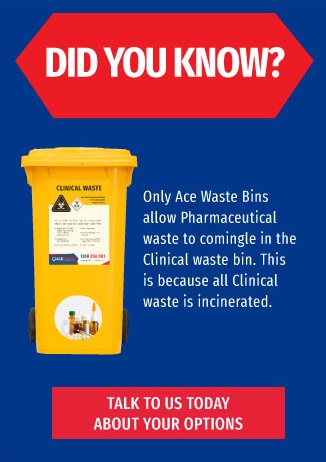
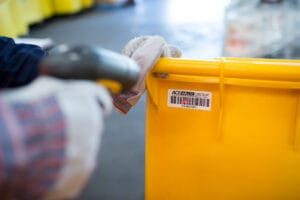
Yellow is the standard colour for general clinical waste across every Australian state and territory. Yellow bins and bags are clearly marked with the black biohazard symbol and the words ‘clinical waste’ on at least two sides. They hold soiled dressings, blood-contaminated materials, used PPE, swabs, disposable instruments, pathology specimens and similar infectious items. Yellow bags also line yellow wheelie bins for safe transport.
Yellow bins with orange lids (anatomical waste)
Anatomical waste, which includes recognisable body parts and tissue from surgery or post-mortem activity, is collected in yellow containers fitted with an orange lid. The orange lid signals that the contents need high-temperature incineration rather than autoclaving, because thermal destruction is the only treatment method that fully renders identifiable human tissue safe and unrecognisable.
Purple bins (cytotoxic waste)
Purple is reserved for cytotoxic waste, which is generated when handling chemotherapy drugs and any items contaminated by them. This includes empty drug vials, IV bags, tubing, gloves, gowns and patient-care items used within 48 hours of cytotoxic treatment. Purple bins carry the cytotoxic telophase symbol and must be incinerated at very high temperatures to destroy the active drug compounds. Healthcare facilities working with chemotherapy can rely on a specialist clinical waste disposal service to manage cytotoxic streams safely alongside their general clinical waste.
Sharps containers (yellow rigid, with coloured lids)
Sharps containers are rigid, puncture-resistant and yellow, complying with AS 4031 or AS/NZS 4261. They take needles, syringes, scalpel blades, lancets, broken glass and any item that could pierce skin. The lid colour indicates the sharps category: a standard yellow lid for general clinical sharps, and a purple lid for cytotoxic sharps. Sharps must never go into a soft yellow bag, and a container should be sealed and replaced once it reaches the manufacturer’s fill line, never overfilled.
Other healthcare streams
Pharmaceutical waste, such as expired or unused medicines, is collected in dedicated containers and incinerated. Quarantine and biosecurity waste, often generated at airports, ports and laboratories, follows separate handling rules under Commonwealth biosecurity legislation.
What goes in a clinical waste bin? A quick reference
Use this as a fast checklist before you bin anything in your facility:
- Yellow clinical bin: soiled dressings, used PPE, pathology specimens, bandages with body fluids
- Yellow bin with orange lid: anatomical and tissue waste
- Purple cytotoxic bin: chemotherapy-contaminated items and PPE
- Yellow sharps container: needles, syringes, scalpels, lancets, glass ampoules
- Purple-lidded sharps container: cytotoxic sharps
What does not belong in a clinical waste bin: general office rubbish, food waste, recyclable packaging, domestic cleaning items or non-contaminated paper. Putting these in clinical bins inflates your disposal costs and wastes incineration capacity, which is one of the most common findings we flag during waste audits at busy GP and dental sites.
Choosing the right bin size
Clinical waste bins in Australia come in a range of sizes to suit your generation rate and storage space. Smaller pails of 20 to 50 litres suit GP rooms, dental surgeries and beauty clinics. Mid-sized 120- and 240-litre wheelie bins work well for medical centres and busy vet practices, while 660- and 1100-litre bins are used by hospitals and large laboratories.
A practical tip from our collections team: aim for your bins to reach roughly two-thirds full at each scheduled pickup. Consistently overflowing bins mean you need a larger size or more frequent collections, while consistently empty ones mean you are paying for capacity you do not use.
Stay compliant, stay safe
Clinical waste compliance comes down to three things: segregating at the source, using the correct colour-coded container and partnering with an EPA-licensed disposal provider that can prove safe treatment from collection to incineration.
Ace Waste has been helping Australian healthcare facilities manage clinical waste since 1987, with high-temperature incineration facilities in Brisbane and Melbourne. Our team works directly with hospitals, dental practices, GPs, vet clinics, aged care homes and laboratories, so we understand the day-to-day realities of segregation in a busy clinical setting.
Ready to simplify your clinical waste? Get in touch with our team for a tailored quote and compliant collection schedule.
Frequently asked questions
1. Can clinical waste go in general waste bins?
No. Clinical waste must stay separate from general rubbish under AS/NZS 3816. Mixing them creates contamination risks and can lead to penalties during an EPA audit.
2. How often should clinical waste bins be collected?
It depends on your volume and facility type. Small clinics often need fortnightly pickups, while hospitals need weekly ones. Aim for bins to reach two-thirds full at each collection.
3. Who is legally responsible for clinical waste once it leaves my facility?
The waste generator carries a duty of care until safe treatment. You must use a licensed provider, keep consignment records and confirm waste reaches an EPA-approved facility.
4. What is the difference between clinical waste and medical waste?
‘Clinical waste’ is the formal term in AS/NZS 3816, covering infectious items from medical, dental and vet procedures. ‘Medical waste’ is a broader everyday term that sometimes includes clinic packaging.